DAP 2
Questions & Answers:
[12/8/2010 7:31:38 PM] Melinda Leong: If you can gie an age, what age can you gie to this person?
[12/8/2010 7:32:09 PM] Shirley Awe: this person is in his early 30s
[12/8/2010 7:32:46 PM] Melinda Leong: The way he is standing, where is this person at present?
[12/8/2010 7:33:31 PM] Shirley Awe: he is standing beside his car
[12/8/2010 7:33:47 PM] Shirley Awe: waiting for some one
[12/8/2010 7:34:00 PM] Shirley Awe: he is suppose to pick someone up from work
[12/8/2010 7:34:56 PM] Melinda Leong: In this picture, what is the thing that he likes most?
[12/8/2010 7:36:03 PM] Shirley Awe: u mean acessories of his body part or hsi general interest?
[12/8/2010 7:36:41 PM] Melinda Leong: Physically, body part, accessories, can be anything.
[12/8/2010 7:37:24 PM] Shirley Awe: he love to go into his spiritual learning/ self enrichment and helping people aroudn him
[12/8/2010 7:37:43 PM] Melinda Leong: u were saying that he is standing there waiting for someone to pick him up, or he is going to pick some up from work?
[12/8/2010 7:38:07 PM] Shirley Awe: he is goin to pick someone up from work
[12/8/2010 7:39:20 PM] Shirley Awe: waiting for her to finish her work at the office carpark
[12/8/2010 7:39:56 PM] Melinda Leong: What type of fashion does he like?
[12/8/2010 7:40:57 PM] Shirley Awe: usually he wears his khakis pants with tshirt and sport shoes if he is not working
[12/8/2010 7:41:45 PM] Melinda Leong: In looking at him now, what emotiong is he more likely expressing in the way, he is standing.
[12/8/2010 7:42:17 PM] Shirley Awe: awaiting to see her, happy and excited
[12/8/2010 7:43:26 PM] Melinda Leong: If there is anything that irritates him or frustate him, what will that be?
[12/8/2010 7:44:01 PM] Shirley Awe: miscommunications,
[12/8/2010 7:44:22 PM] Shirley Awe: people who are not willing to open up their heart to talk about an issues/conflict
[12/8/2010 7:46:15 PM] Melinda Leong: If he has a chance, what can he do to minimised the miscommunication?
[12/8/2010 7:47:19 PM] Shirley Awe: happy if he can open up people's heart to talk about the miscommunication
[12/8/2010 7:47:35 PM] Shirley Awe: as most peopel tends to hide and run aways from problems
[12/8/2010 7:48:17 PM] Shirley Awe: infact, there are always lessons to learn behind every problems
[12/8/2010 7:48:47 PM] Melinda Leong: In his line of work, what is his job?
[12/8/2010 7:49:51 PM] Shirley Awe: he is an art therapist
[12/8/2010 7:51:58 PM] Shirley Awe: he job is to help people to realise the root of an issue, how to solve that and how to make it better
[12/8/2010 7:52:15 PM] Melinda Leong: What is he hold in his left hand?
[12/8/2010 7:52:23 PM] Shirley Awe: a book
[12/8/2010 7:52:40 PM] Shirley Awe: spiritual/self enrichment book that he love the most
[12/8/2010 7:53:24 PM] Melinda Leong: What title or a phrase can you give to this picture?
[12/8/2010 7:54:00 PM] Shirley Awe: my love, my inspirations
Melinda's Summary
In this picture, this 30 years old person is standing beside his car waiting to pick someone up from her work. He loe to go into : In this picture, he is seen waiting for some to finish her work at the office car park, waiting to see this someone - with a happy He loves to wears khakis pants with a t-shirt and sport shoe in his off day.
Does not like mis-communication but tries to minimize it by trying to open up people heart, to talk about their miscommunication.
But sometimes it does not work his way, bcos ppl tend to hide and runaway from their problem.
But he takes it with an open heart, he takes it as an learning process lesson\.
he is an art therapist - happily helping ppl to realize the root of issue, to solve and to make things better.
Title: My Love, My Inspiration.
Wednesday, August 18, 2010

DAP 1~ Reflections
First of all, thanks to Melinda for being such a wonderful partner in this assignment. And also I Ling for her great advises.
DAP 1
Questions & Answers:
12/8/2010 7:10:06 PM] Melinda Leong: Let's do the 1st picture
[12/8/2010 7:10:26 PM] Shirley Awe: grandmother pic
[12/8/2010 7:10:27 PM] Shirley Awe: ?
[12/8/2010 7:10:51 PM] Melinda Leong: yes.
[12/8/2010 7:10:55 PM] Shirley Awe: ok
[12/8/2010 7:11:02 PM] Shirley Awe: im ready
[12/8/2010 7:11:47 PM] Melinda Leong: If u can give an age, what aga can u give to this person?
[12/8/2010 7:12:06 PM] Shirley Awe: this person is old
[12/8/2010 7:12:17 PM] Shirley Awe: 80yrs old
[12/8/2010 7:12:43 PM] Melinda Leong: In this picture, where is she at present?
[12/8/2010 7:13:02 PM] Shirley Awe: she is currently at home
[12/8/2010 7:13:13 PM] Shirley Awe: infront of the gate
[12/8/2010 7:13:50 PM] Melinda Leong: Can you describe this person current home?
[12/8/2010 7:14:29 PM] Shirley Awe: she is staying at a double storey terrace house,
[12/8/2010 7:14:35 PM] Shirley Awe: she is alone most of the time
[12/8/2010 7:15:34 PM] Shirley Awe: usually she will have her grandson to accompany her at nite after he return from work
[12/8/2010 7:15:59 PM] Shirley Awe: and occasioanaly visits from friends and relatives
[12/8/2010 7:16:39 PM] Melinda Leong: In looking at the person, what emotion is she more likely to express in the way she is standing?
[12/8/2010 7:17:11 PM] Shirley Awe: she is feeling calm and happy
[12/8/2010 7:17:33 PM] Shirley Awe: as if she is awaiting for the arrival of somebody
[12/8/2010 7:19:01 PM] Melinda Leong: By the way of this person pose standing at infront of the gate, there will be people passing by, what can the people see her
emotionly?
[12/8/2010 7:19:38 PM] Shirley Awe: happy and proud
[12/8/2010 7:20:35 PM] Melinda Leong: If this person is to make the clohes that she is wearing now, what colour wil she choose?
[12/8/2010 7:21:14 PM] Shirley Awe: she will choose grey, beige,
[12/8/2010 7:21:31 PM] Shirley Awe: very pastel, soft color
[12/8/2010 7:22:10 PM] Melinda Leong: If into a situation, what will provoke her to be angry?
[12/8/2010 7:22:41 PM] Shirley Awe: someone being disrespectful to her
[12/8/2010 7:23:06 PM] Shirley Awe: saying bad stuff about her which are not true
[12/8/2010 7:24:09 PM] Melinda Leong: If you look at the picture again, if there was a word or phase that you can associate in creating a title what will it be?
[12/8/2010 7:25:06 PM] Shirley Awe: my loving grandmother, i miss you alot
[12/8/2010 7:26:16 PM] Melinda Leong: So, correct me if I am wrong, the person is currently at home, infront of the gate at her double story terrace house, alone most
of the time until her grandson return, yeah?
[12/8/2010 7:26:37 PM] Melinda Leong: She felt calm and happy, happy and proud seen by the pass by.
[12/8/2010 7:26:55 PM] Melinda Leong: Wearing a grey and beige, pastel soft colour clothing.
[12/8/2010 7:27:01 PM] Shirley Awe: yes
[12/8/2010 7:27:19 PM] Shirley Awe: she is most happy to see her relative coming back/visiting to her
[12/8/2010 7:27:50 PM] Melinda Leong: Is there anything that stand out to you in this person in this picture?
[12/8/2010 7:28:28 PM] Shirley Awe: u mean physically?
[12/8/2010 7:28:42 PM] Melinda Leong: Yup.
[12/8/2010 7:30:02 PM] Shirley Awe: she has a very beautiful face and also her breast
Melinda's Summary
The person is currently at home, infront of the gate at her double story terrace house, alone most of the time until her grandson return.
She felt calm and happy, happy and proud seen by the pass by.
Wearing a grey and beige, pastel soft colour clothing.
She is most happy to see her relative coming back/visiting to her.
Title: My loving grandmother, I miss you alot
DAP 1
Questions & Answers:
12/8/2010 7:10:06 PM] Melinda Leong: Let's do the 1st picture
[12/8/2010 7:10:26 PM] Shirley Awe: grandmother pic
[12/8/2010 7:10:27 PM] Shirley Awe: ?
[12/8/2010 7:10:51 PM] Melinda Leong: yes.
[12/8/2010 7:10:55 PM] Shirley Awe: ok
[12/8/2010 7:11:02 PM] Shirley Awe: im ready
[12/8/2010 7:11:47 PM] Melinda Leong: If u can give an age, what aga can u give to this person?
[12/8/2010 7:12:06 PM] Shirley Awe: this person is old
[12/8/2010 7:12:17 PM] Shirley Awe: 80yrs old
[12/8/2010 7:12:43 PM] Melinda Leong: In this picture, where is she at present?
[12/8/2010 7:13:02 PM] Shirley Awe: she is currently at home
[12/8/2010 7:13:13 PM] Shirley Awe: infront of the gate
[12/8/2010 7:13:50 PM] Melinda Leong: Can you describe this person current home?
[12/8/2010 7:14:29 PM] Shirley Awe: she is staying at a double storey terrace house,
[12/8/2010 7:14:35 PM] Shirley Awe: she is alone most of the time
[12/8/2010 7:15:34 PM] Shirley Awe: usually she will have her grandson to accompany her at nite after he return from work
[12/8/2010 7:15:59 PM] Shirley Awe: and occasioanaly visits from friends and relatives
[12/8/2010 7:16:39 PM] Melinda Leong: In looking at the person, what emotion is she more likely to express in the way she is standing?
[12/8/2010 7:17:11 PM] Shirley Awe: she is feeling calm and happy
[12/8/2010 7:17:33 PM] Shirley Awe: as if she is awaiting for the arrival of somebody
[12/8/2010 7:19:01 PM] Melinda Leong: By the way of this person pose standing at infront of the gate, there will be people passing by, what can the people see her
emotionly?
[12/8/2010 7:19:38 PM] Shirley Awe: happy and proud
[12/8/2010 7:20:35 PM] Melinda Leong: If this person is to make the clohes that she is wearing now, what colour wil she choose?
[12/8/2010 7:21:14 PM] Shirley Awe: she will choose grey, beige,
[12/8/2010 7:21:31 PM] Shirley Awe: very pastel, soft color
[12/8/2010 7:22:10 PM] Melinda Leong: If into a situation, what will provoke her to be angry?
[12/8/2010 7:22:41 PM] Shirley Awe: someone being disrespectful to her
[12/8/2010 7:23:06 PM] Shirley Awe: saying bad stuff about her which are not true
[12/8/2010 7:24:09 PM] Melinda Leong: If you look at the picture again, if there was a word or phase that you can associate in creating a title what will it be?
[12/8/2010 7:25:06 PM] Shirley Awe: my loving grandmother, i miss you alot
[12/8/2010 7:26:16 PM] Melinda Leong: So, correct me if I am wrong, the person is currently at home, infront of the gate at her double story terrace house, alone most
of the time until her grandson return, yeah?
[12/8/2010 7:26:37 PM] Melinda Leong: She felt calm and happy, happy and proud seen by the pass by.
[12/8/2010 7:26:55 PM] Melinda Leong: Wearing a grey and beige, pastel soft colour clothing.
[12/8/2010 7:27:01 PM] Shirley Awe: yes
[12/8/2010 7:27:19 PM] Shirley Awe: she is most happy to see her relative coming back/visiting to her
[12/8/2010 7:27:50 PM] Melinda Leong: Is there anything that stand out to you in this person in this picture?
[12/8/2010 7:28:28 PM] Shirley Awe: u mean physically?
[12/8/2010 7:28:42 PM] Melinda Leong: Yup.
[12/8/2010 7:30:02 PM] Shirley Awe: she has a very beautiful face and also her breast
Melinda's Summary
The person is currently at home, infront of the gate at her double story terrace house, alone most of the time until her grandson return.
She felt calm and happy, happy and proud seen by the pass by.
Wearing a grey and beige, pastel soft colour clothing.
She is most happy to see her relative coming back/visiting to her.
Title: My loving grandmother, I miss you alot
Monday, August 9, 2010

Sunday, August 8, 2010

Task 1 – Understanding Artists and their Art. - Paul Gauguin ~Where Do We Come From? What Are We Doing? Where Are We Going?


Int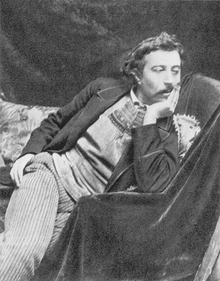 roducing Paul Gauguin
Eugène Henri Paul Gauguin, 7 June 1848 – 8 May 1903) was a leading Post-Impressionist artist, painter, sculptor, printmaker, ceramist and writer. His bold experimentation with colouring led directly to the Synthetist style of modern art while his expression of the inherent meaning of the subjects in his paintings, under the influence of the cloisonnist style, paved the way to Primitivism and the return to the pastoral. He was also an influential proponent of wood engraving and woodcuts as art forms.
Under the influence of folk art and Japanese prints, Gauguin evolved towards Cloisonnism, a style given its name by the critic Édouard Dujardin in response to Emile Bernard's method of painting with flat areas of color and bold outlines, which reminded Dujardin of the Medieval cloisonné enamelling technique. Gauguin was very appreciative of Bernard's art and of his daring with the employment of a style which suited Gauguin in his quest to express the essence of the objects in his art. Gauguin paid little attention to classical perspective and boldly eliminated subtle gradations of colour, thereby dispensing with the two most characteristic principles of post-Renaissance painting. His painting later evolved towards Synthetism in which neither form nor colour predominate but each has an equal role.
Living in Mataiea Village in Tahiti, he painted "Fatata te Miti" ("By the Sea"), "Ia Orana Maria" (Ave Maria) and other depictions of Tahitian life. He moved to Punaauia in 1897, where he created the masterpiece painting "Where Do We Come From" and then lived the rest of his life in the Marquesas Islands, returning to France only once, when he painted at Pont-Aven.
His works of that period are full of quasi-religious symbolism and an exoticized view of the inhabitants of Polynesia. In Polynesia, he sided with the native peoples, clashing often with the colonial authorities and with the Catholic Church. During this period he also wrote the book Avant et après (before and after), a fragmented collection of observations about life in Polynesia, memories from his life and comments on literature and paintings.
Primitivism was an art movement of late 19th century painting and sculpture; characterized by exaggerated body proportions, animal totems, geometric designs and stark contrasts. The first artist to systematically use these effects and achieve broad public success was Paul Gauguin. The European cultural elite discovering the art of Africa, Micronesia, and Native Americans for the first time were fascinated, intrigued and educated by the newness, wildness and the stark power embodied in the art of those faraway places. Like Pablo Picasso in the early days of the 20th century, Gauguin was inspired and motivated by the raw power and simplicity of the so-called Primitive art of those foreign cultures.
Gauguin is also considered a Post-Impressionist painter. His bold, colorful and design oriented paintings significantly influenced Modern art. Gauguin's influence on artists and movements in the early 20th century include Vincent van Gogh, Henri Matisse, Pablo Picasso, Georges Braque, André Derain, Fauvism, Cubism and Orphism, among others. Later he influenced Arthur Frank Mathews and the American Arts and Crafts Movement.
Where Do We Come From? What Are We Doing? Where Are We Going?
 roducing Paul Gauguin
Eugène Henri Paul Gauguin, 7 June 1848 – 8 May 1903) was a leading Post-Impressionist artist, painter, sculptor, printmaker, ceramist and writer. His bold experimentation with colouring led directly to the Synthetist style of modern art while his expression of the inherent meaning of the subjects in his paintings, under the influence of the cloisonnist style, paved the way to Primitivism and the return to the pastoral. He was also an influential proponent of wood engraving and woodcuts as art forms.
Under the influence of folk art and Japanese prints, Gauguin evolved towards Cloisonnism, a style given its name by the critic Édouard Dujardin in response to Emile Bernard's method of painting with flat areas of color and bold outlines, which reminded Dujardin of the Medieval cloisonné enamelling technique. Gauguin was very appreciative of Bernard's art and of his daring with the employment of a style which suited Gauguin in his quest to express the essence of the objects in his art. Gauguin paid little attention to classical perspective and boldly eliminated subtle gradations of colour, thereby dispensing with the two most characteristic principles of post-Renaissance painting. His painting later evolved towards Synthetism in which neither form nor colour predominate but each has an equal role.
Living in Mataiea Village in Tahiti, he painted "Fatata te Miti" ("By the Sea"), "Ia Orana Maria" (Ave Maria) and other depictions of Tahitian life. He moved to Punaauia in 1897, where he created the masterpiece painting "Where Do We Come From" and then lived the rest of his life in the Marquesas Islands, returning to France only once, when he painted at Pont-Aven.
His works of that period are full of quasi-religious symbolism and an exoticized view of the inhabitants of Polynesia. In Polynesia, he sided with the native peoples, clashing often with the colonial authorities and with the Catholic Church. During this period he also wrote the book Avant et après (before and after), a fragmented collection of observations about life in Polynesia, memories from his life and comments on literature and paintings.
Primitivism was an art movement of late 19th century painting and sculpture; characterized by exaggerated body proportions, animal totems, geometric designs and stark contrasts. The first artist to systematically use these effects and achieve broad public success was Paul Gauguin. The European cultural elite discovering the art of Africa, Micronesia, and Native Americans for the first time were fascinated, intrigued and educated by the newness, wildness and the stark power embodied in the art of those faraway places. Like Pablo Picasso in the early days of the 20th century, Gauguin was inspired and motivated by the raw power and simplicity of the so-called Primitive art of those foreign cultures.
Gauguin is also considered a Post-Impressionist painter. His bold, colorful and design oriented paintings significantly influenced Modern art. Gauguin's influence on artists and movements in the early 20th century include Vincent van Gogh, Henri Matisse, Pablo Picasso, Georges Braque, André Derain, Fauvism, Cubism and Orphism, among others. Later he influenced Arthur Frank Mathews and the American Arts and Crafts Movement.
Where Do We Come From? What Are We Doing? Where Are We Going?
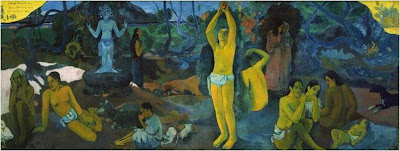 Paul Gauguin, 1897–1898
oil on canvas, 139.1 × 374.6 cm
Museum of Fine Arts, Boston
"This is Gauguin's ultimate masterpiece. He claimed that he did not think of the long title until the work was finished, but he is known to have been creative with the truth. The picture is so superbly organized into three "scoops" - a circle to right and to left, and a great oval in the center - that I cannot but believe he had his questions in mind from the start. I am often tempted to forget that these are questions, and to think that he is suggesting answers, but there are no answers here; there are three fundamental questions, posed visually.
"On the right (Where do we come from?), we see the baby, and three young women - those who are closest to that eternal mystery. In the center, Gauguin meditates on what we are. Here are two women, talking about destiny (or so he described them), a man looking puzzled and half-aggressive, and in the middle, a youth plucking the fruit of experience. This has nothing to do, I feel sure, with the Garden of Eden; it is humanity's innocent and natural desire to live and to search for more life. A child eats the fruit, overlooked by the remote presence of an idol - emblem of our need for the spiritual. There are women (one mysteriously curled up into a shell), and there are animals with whom we share the world: a goat, a cat, and kittens. In the final section (Where are we going?), a beautiful young woman broods, and an old woman prepares to die. Her pallor and gray hair tell us so, but the message is underscored by the presence of a strange white bird. I once described it as "a mutated puffin," and I do not think I can do better. It is Gauguin's symbol of the afterlife, of the unknown (just as the dog, on the far right, is his symbol of himself). The blue idol in the background apparently represents what Gauguin described as "the Beyond."
All this is set in a paradise of tropical beauty: the Tahiti of sunlight, freedom, and color that Gauguin left everything to find. A little river runs through the woods, and behind it is a great slash of brilliant blue sea, with the misty mountains of another island rising beyond Gauguin wanted to make it absolutely clear that this picture was his testament. He seems to have concocted a story that, being ill and unappreciated (that part was true enough), he determined on suicide - the great refusal. He wrote to a friend, describing his journey into the mountains with arsenic. Then he found himself still alive, and returned to paint more masterworks. It is sad that so great an artist felt he needed to manufacture a ploy to get people to appreciate his work.
Thursday, August 5, 2010
Task 1 – Understanding Artists and their Art. - Salvador Dali ~ Apparition of Face and Fruit Dish on a Beach
Introducing Salvador Dali
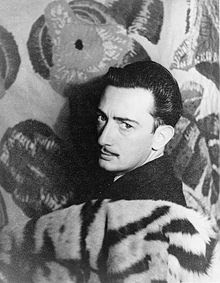 In the rather peaceful years following WW1, other movements that will replace Dada, with Surrealism being the first and most descendant. Andre Breton was the instigator of Surrealism in 1924. A writer, not an artist, Breton followed the Dada philosophy of allowing things to happen naturally in his work rather than putting words together in a logical way. His emphasis on a dream world, word association games and unconscious writing was carried into the visual world of Surrealist painters and sculptors. Salvador Dali put his fantastic ideas and dreams on canvas in the Surrealist movement.
Salvador Domingo Felipe Jacinto Dalí i Domènech (May 11, 1904 – January 23, 1989), commonly known as Salvador Dalí, was a prominent surrealist painter born in Figueres.
Dalí was a skilled draftsman, best known for the striking and bizarre images in his surrealist work. His painterly skills are often attributed to the influence of Renaissance masters. His best-known work, The Persistence of Memory, was completed in 1931. Dalí's expansive artistic repertoire includes film, sculpture, and photography, in collaboration with a range of artists in a variety of media.
His life itself was so thoroughly surrealistic-his wild actions, his weird utterances, his flamboyant clothing-that his integrity as an artist has often been questioned. Dalí attributed his "love of everything that is gilded and excessive, my passion for luxury and my love of oriental clothes" to a self-styled "Arab lineage," claiming that his ancestors were descended from the Moors.
Dalí was highly imaginative, and also had an affinity for partaking in unusual and grandiose behavior, in order to draw attention to himself. His personal painting style, influenced at first by Picasso and Miro, soon developed into a magical presentation of incredible draughtsmanship and three-dimensional space. Dali uses exacting realism in every part of his paintings because he claimed to "hate simplicity in all its forms," thus rejecting abstraction of any other simplified form of art.
Later in his life, Dali began painting religious subject with his unique style and symbolism. His detail and painting techniques are wonders to craftsmanship. The composition is designed and carried out meticulously. The image, as in all Surrealist and Fantasy art, leaves the viewer with more questions than answers.
Dali transformed the definition of Surrealism, expressing the unconscious process of thought, dream and associated realities through his paintings and drawings. An eccentric and masterful Surrealist in painting and in life, Dali wrote in his diary two years before entering art school in Madrid during the early 1920s: "Perhaps I’ll be despised and misunderstood, . . . but I’ll be a great genius."
Dalí subsequently embraced the psychoanalytic theories of Sigmund Freud, assimilating them into his paintings. The artist's invention of the Paranoiac-Critical method allowed Dalí to explore the deepest recesses of the subconscious while producing many of his complex career's most recognizable works.
Throughout his life, Dali cultivated eccentricity and a predisposition towards narcissistic exhibitionism, claiming that his creative energies were derived from it. The spectrum of imagery from fantastic to nightmarish visions which Dali produced are the supreme evidence of these idiosyncrasies.
Works
The Persistence of Memory (1931)
Face of Mae West Which May Be Used as an Apartment, (1935)
Soft Construction with Boiled Beans (Premonition of Civil War) (1936)
Swans Reflecting Elephants (1937)
Ballerina in a Death's Head (1939)
The Temptation of St. Anthony (1946)
Galatea of the Spheres (1952)
Crucifixion (Corpus Hypercubus) (1954)
Apparition of Face and Fruit Dish on a Beach
 Artist Salvador Dalí
Year 1938
Type Oil on canvas
Dimensions 114.8 cm × 143.8 cm (45.2 in × 56.6 in)
Location Wadsworth Atheneum, Hartford, Connecticut
This is one of my favorite painting of all time! I came across this painting in my Art History class back in 2000. I get to have a more detail look at it again later from the art history book which I loan from the library. After moments of staring at it, I was really shocked when I saw two subjects in 1 painting which was painted in 2 different dimension/perspective. Dali really inspired me after that.
I was running around crazily to my room mates after that, showing them and testing them if they can see what I have just saw. ( can you see?? YES YOU!!!)
(There are four scenes in one : you can see an Afghan dog, a face, a table with a fruit dish in the middle and a desert landscape looking out on the sea. The bridge in the landscape is the dog's collar, the figure in the desert is nose and mouth of the face.)
This oil on canvas masterpiece exemplifies the artist's refinement of his Paranoiac-Critical method. The painting combines multiple embedded images of a dog, human face and a fruit dish with pears on a tabletop against a beach landscape. One image's contours meld seamlessly into those of another, creating a heightened sense of visual drama meant to disturb the viewer.
In the rather peaceful years following WW1, other movements that will replace Dada, with Surrealism being the first and most descendant. Andre Breton was the instigator of Surrealism in 1924. A writer, not an artist, Breton followed the Dada philosophy of allowing things to happen naturally in his work rather than putting words together in a logical way. His emphasis on a dream world, word association games and unconscious writing was carried into the visual world of Surrealist painters and sculptors. Salvador Dali put his fantastic ideas and dreams on canvas in the Surrealist movement.Salvador Domingo Felipe Jacinto Dalí i Domènech (May 11, 1904 – January 23, 1989), commonly known as Salvador Dalí, was a prominent surrealist painter born in Figueres.
Dalí was a skilled draftsman, best known for the striking and bizarre images in his surrealist work. His painterly skills are often attributed to the influence of Renaissance masters. His best-known work, The Persistence of Memory, was completed in 1931. Dalí's expansive artistic repertoire includes film, sculpture, and photography, in collaboration with a range of artists in a variety of media.
His life itself was so thoroughly surrealistic-his wild actions, his weird utterances, his flamboyant clothing-that his integrity as an artist has often been questioned. Dalí attributed his "love of everything that is gilded and excessive, my passion for luxury and my love of oriental clothes" to a self-styled "Arab lineage," claiming that his ancestors were descended from the Moors.
Dalí was highly imaginative, and also had an affinity for partaking in unusual and grandiose behavior, in order to draw attention to himself. His personal painting style, influenced at first by Picasso and Miro, soon developed into a magical presentation of incredible draughtsmanship and three-dimensional space. Dali uses exacting realism in every part of his paintings because he claimed to "hate simplicity in all its forms," thus rejecting abstraction of any other simplified form of art.
Later in his life, Dali began painting religious subject with his unique style and symbolism. His detail and painting techniques are wonders to craftsmanship. The composition is designed and carried out meticulously. The image, as in all Surrealist and Fantasy art, leaves the viewer with more questions than answers.
Dali transformed the definition of Surrealism, expressing the unconscious process of thought, dream and associated realities through his paintings and drawings. An eccentric and masterful Surrealist in painting and in life, Dali wrote in his diary two years before entering art school in Madrid during the early 1920s: "Perhaps I’ll be despised and misunderstood, . . . but I’ll be a great genius."
Dalí subsequently embraced the psychoanalytic theories of Sigmund Freud, assimilating them into his paintings. The artist's invention of the Paranoiac-Critical method allowed Dalí to explore the deepest recesses of the subconscious while producing many of his complex career's most recognizable works.
Throughout his life, Dali cultivated eccentricity and a predisposition towards narcissistic exhibitionism, claiming that his creative energies were derived from it. The spectrum of imagery from fantastic to nightmarish visions which Dali produced are the supreme evidence of these idiosyncrasies.
Works
The Persistence of Memory (1931)
Face of Mae West Which May Be Used as an Apartment, (1935)
Soft Construction with Boiled Beans (Premonition of Civil War) (1936)
Swans Reflecting Elephants (1937)
Ballerina in a Death's Head (1939)
The Temptation of St. Anthony (1946)
Galatea of the Spheres (1952)
Crucifixion (Corpus Hypercubus) (1954)
Apparition of Face and Fruit Dish on a Beach
Artist Salvador DalíYear 1938
Type Oil on canvas
Dimensions 114.8 cm × 143.8 cm (45.2 in × 56.6 in)
Location Wadsworth Atheneum, Hartford, Connecticut
This is one of my favorite painting of all time! I came across this painting in my Art History class back in 2000. I get to have a more detail look at it again later from the art history book which I loan from the library. After moments of staring at it, I was really shocked when I saw two subjects in 1 painting which was painted in 2 different dimension/perspective. Dali really inspired me after that.
I was running around crazily to my room mates after that, showing them and testing them if they can see what I have just saw. ( can you see?? YES YOU!!!)
(There are four scenes in one : you can see an Afghan dog, a face, a table with a fruit dish in the middle and a desert landscape looking out on the sea. The bridge in the landscape is the dog's collar, the figure in the desert is nose and mouth of the face.)
This oil on canvas masterpiece exemplifies the artist's refinement of his Paranoiac-Critical method. The painting combines multiple embedded images of a dog, human face and a fruit dish with pears on a tabletop against a beach landscape. One image's contours meld seamlessly into those of another, creating a heightened sense of visual drama meant to disturb the viewer.
Sunday, August 1, 2010
002 Sumo Paint~~Growing Up!
 She is growing up day by day, exploring the new world together with us.
Im so glad I found you, you are part of our life.
Love you Nicholle.
Subscribe to:
Posts (Atom)